Cabo de Shanghai Shenghua (grupo) Co., Ltd.

Guia Prático por Shenghua Cable
Escolher a área correta da seção transversal do cabo é fundamental para a segurança elétrica, eficiência e custo-benefício. Embora muitos engenheiros confiem na experiência ou em fórmulas simplificadas, uma abordagem científica garante confiabilidade a longo prazo e desempenho ideal. Com base em décadas de experiência, Shenghua Cable (Shanghai Shenghua Cable Technology Group Co., Ltd.) apresenta quatro métodos práticos para determinar a seção transversal correta do cabo para diferentes aplicações.
Descubra a linha completa de produtos da Shenghua Cable aqui:https://www.shanpowercable.com/
O método mais direto é garantir que um cabo não exceda sua temperatura operacional a longo prazo sob carga normal.
Cabo com isolamento de PVC: 70°C
Cabo com isolamento de XLPE: 90°C
Exemplo:
Capacidade do transformador: 2500 kVA
Tensão de alimentação: 10 kV
Tipo de cabo: XLPE, instalado em ponte de cabos
Passo 1: Calcular a corrente nominal
I=250010.5*1.732≈137AI = frac{2500}{10.5 times 1.732} approx 137A
Passo 2: Consultar o manual do cabo
YJV-8.7/10KV-3X25 → 120A
YJV-8.7/10KV-3X35 → 140A
Passo 3: Selecionar o cabo
YJV-8.7/10KV-3X35 atende a 137A
Observação: Este método não leva em consideração a queda de tensão ou a estabilidade térmica em caso de curto-circuito.
Este método equilibra custo do material e perda de energia. Cabos menores reduzem o investimento, mas aumentam as perdas; cabos maiores reduzem as perdas, mas aumentam o custo. O tamanho ideal é determinado usando a densidade de corrente econômica (A/mm²) com base nas horas de operação do equipamento.
Exemplo:
Corrente nominal do equipamento: 150A
Horas anuais de operação: 8000 horas
Densidade de corrente econômica: 1.75 A/mm²
S=Ieconomic density=1501.75≈85.7 mm²S = frac{I}{text{economic density}} = frac{150}{1.75} approx 85.7 text{ mm²}
Passo 2: Selecionar o tamanho padrão mais próximo → 95 mm²
Este método garante segurança e custo-benefício.
Para longas distâncias de cabo, a queda de tensão torna-se significativa e pode afetar a operação do equipamento. A queda permitida é frequentemente 7% para uma linha de 400V.
Fórmula da queda de tensão:
S=I⋅ρ⋅LΔUS = frac{Icdot rho cdot L}{Delta U}
III = corrente nominal
ρrhoρ = resistividade do condutor
LLL = comprimento do cabo
ΔUDelta UΔU = queda de tensão permitida
Exemplo:
Tensão do dispositivo: 380V
Corrente nominal: 150A
Resistividade do cabo de cobre: 0.0175 Ω·mm²/m
Comprimento do cabo: 600 m
Queda de tensão permitida: 26.6V
S=150*0.0175*60026.6≈59.2 mm²S = frac{150 times 0.0175 times 600}{26.6} approx 59.2 text{ mm²}
Passo 2: Selecionar o tamanho padrão mais próximo → 70 mm²
Isso garante a estabilidade da tensão em longas distâncias de cabo.
Para cabos de média e alta tensão (≥6 kV), a seleção da seção transversal deve levar em conta a estabilidade térmica em caso de curto-circuito.
Fórmula:
Smin=IdtiCS_{text{min}} = frac{I_d sqrt{t_i}}{C}
IdI_dId = corrente de curto-circuito
tit_iti = tempo de interrupção do disjuntor
CCC = coeficiente térmico do cabo (tipicamente 80)
Exemplo:
Corrente de curto-circuito: 18 kA
Coeficiente térmico: 80
Tempo do disjuntor: 0.25 s
Smin=18000*0.2580≈112.5 mm²S_{text{min}} = frac{18000 times sqrt{0.25}}{80} approx 112.5 text{ mm²}
Passo 2: Selecionar o tamanho padrão mais próximo → 120 mm²
Mesmo que a corrente nominal seja pequena, o cabo deve suportar o estresse de curto-circuito.
Ao combinar métodos de seleção científica com fabricação de qualidade, Shenghua Cable garante:
Dimensionamento preciso da seção transversal para segurança e eficiência
Desempenho térmico e elétrico confiável
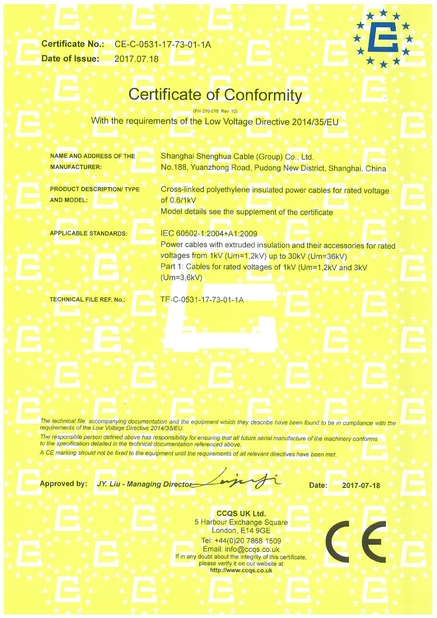
Conformidade com normas e certificações internacionais
Durabilidade a longo prazo em sistemas industriais e de distribuição de energia
A Shenghua Cable oferece orientação completa e suporte técnico para dimensionamento de cabos específico para cada projeto.
Explore nosso portfólio de produtos:https://www.shanpowercable.com/
Selecionar a área correta da seção transversal do cabo é mais do que seguir a experiência. Ao considerar capacidade de corrente a longo prazo, densidade econômica, queda de tensão e estabilidade térmica em caso de curto-circuito, os engenheiros podem garantir instalações seguras, confiáveis e econômicas.
Shenghua Cable combina expertise técnica com materiais de alta qualidade para fornecer soluções que resistem ao teste do tempo.